Yellow Line (Line 3), RV Road to Bommasandra. Inaugurated 10 August 2025, public service from 11 August 2025. 19.15 km, 16 stations, fully elevated, depot at Hebbagodi. The ordered sequence is RV Road, Ragigudda, Jayadeva Hospital, BTM Layout, Central Silk Board, Bommanahalli, Hongasandra, Kudlu Gate, Singasandra, Hosa Road, Beratena Agrahara, Electronic City, Infosys Foundation Konappana Agrahara, Huskur Road, Biocon Hebbagodi, Bommasandra.
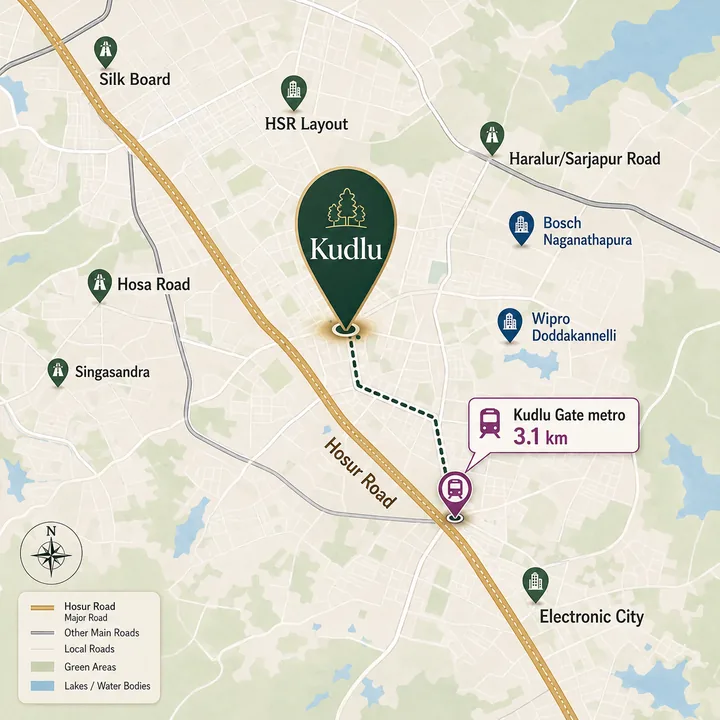
Three consecutive stations on that list sit within a short drive of the project, and all three carry PIN 560068 — the project's own.
| Station | Straight-line from site | By road | Detour factor | Status |
|---|
| Kudlu Gate | 2.79 km | ~3.1 km — nearest by road | 1.12× | Operational, staffed, step-free |
| Hosa Road | 2.35 km | ~3.7–5.3 km | 1.59× | Operational, staffed, step-free |
| Singasandra | 2.32 km — nearest as the crow flies | ~4.3–6.4 km — farthest by road | 2.07× | Operational, staffed, step-free |
Why the nearest station on a map is not the nearest station in a car
This is the one thing about this location that most published material gets wrong, and it is worth stating plainly.
Measured as the crow flies, Singasandra is the closest station at 2.32 km. Measured on the actual road network, it is the farthest — between 4.3 km and 6.4 km depending on which egress you take. The reason is structural: Hosur Road at this point is an elevated expressway with service roads and a continuous median. You cannot cross it where the straight line wants you to. Every routing engine, on every alternative it generates, puts Singasandra farther by road than Kudlu Gate.
Kudlu Gate is the station residents will actually use. At ~3.1 km by road it is the shortest run from the site, and it is the most reliable figure in the whole set — two independent routing engines agreed on it to within ten metres, and a separate locality source independently gives 3.4 km as the nearest metro to Haralur Road. The route runs out via the site access road to Kudlu Road and onto Hosur Road. Kudlu Gate station has two exits, and Exit 2 serves Kudlu Gate Village and the lake side — the residential approach rather than the industrial one.
Anyone comparing apartments near Kudlu Gate metro station against apartments near Hosa Road or Singasandra should apply the same correction. Straight-line proximity in this pocket systematically overstates access, and the further north-east you go from Hosur Road, the worse the gap gets.
Frequency, interchanges and where the line actually takes you
Frequency has tightened steadily since opening. The line launched on a 25-minute headway; as of 2026 it runs at approximately 7 minutes at peak and 10–12 minutes off-peak, with BMRCL targeting 4–5 minutes once all fifteen three-car trainsets are in service. Daily Yellow Line ridership is around 84,000, on a network that has passed one million.
Only one interchange is live today: RV Road, onto the Green Line. Two more are under construction and should not be treated as usable yet — Jayadeva Hospital (Pink Line) and Central Silk Board (Blue Line). The Pink Line's Jayadeva interchange is the one that materially changes this location's reach, and it is a target rather than a date.
What already works, with no interchange at all, is the southbound employment run. From Kudlu Gate it is four stops to Electronic City station, five to Infosys Foundation Konappana Agrahara, seven to Biocon Hebbagodi. From Hosa Road it is two, three and five respectively. That converts the Electronic City commute from a Hosur Road traffic problem into a rail journey — which is a far more durable asset than any drive-time claim. Companies in the township are reported to be running last-mile shuttles from the two Electronic City stations, and the corridor's rail option has been credited with strengthening return-to-office policies. The same line reaches SNN Electronic City territory in under fifteen minutes of running time.
The last mile — stated honestly
The site is not walkable to any metro station. Kudlu Gate at ~3.1 km is roughly a 40-minute walk; Hosa Road at 3.7–5.3 km is 50 minutes or more. The site itself sits about 830 m back from Haralur Road proper, an 11-minute walk before the onward journey even begins. Published research puts the walking tolerance of metro users at around 20 minutes — this site is beyond that threshold for every station, and no framing changes that. Station car parking is reported as two-wheeler-only, so park-and-ride by car should not be assumed.
The real answer is the feeder network. BMTC and BMRCL launched eight Yellow Line feeder bus routes in March 2026. Two of them are ring services anchored on Hosa Road metro station whose published stop lists include Haralur and Haralur Cross — on the project's own road.
- Ring route, clockwise: Hosa Road Metro → Central Prison → National Public School → Haralur → Haralur Cross → Agara → Parangipalya → Somasundarapalya → Kudlu Gate → Singasandra → Hosa Road Metro. 6:00 AM to 9:40 PM.
- Ring route, counter-clockwise: the same loop reversed, 6:15 AM to 9:20 PM.
- Linear feeder: Hosa Road Metro ↔ Central Prison → Doddamara → Chikkanayakanahalli → Doddakanneli → Carmelaram. 6:00 AM to 9:00 PM.
Peak frequency runs 15–30 minutes depending on route. A single ring service touches all three of the project's nearby stations. Beyond the buses, auto-rickshaws operate along Haralur Road and are available at Kudlu Gate station, shared autos run at roughly ₹10–20 per person, and app-based cabs serve all Yellow Line stations.